
BRASS QUINTET
Concerto no. 4 in E-Flat, k. 495 – III. Rondo
Wolfgang Amadeus Mozart
Arranged for Brass Quintet by Michael Drennan
One of the first pieces I ever arranged. Originally I did a straight, business as usual transcription. I played the midi file for my Brass Quintet and they said it needed something. That something took a while to find, but it finally made it’s way to performance. The hemiola start off rather basic and simple, and by the end of the piece it builds into a full phrase of the rondo over hemiola. If you are going to perform this version, I recommend taking out the grace notes in the rondo. The grace note would never sound right with the hemiola.
Available from:


Adoramus Te
Quirino Gasparini
Arranged for Brass Quintet by Michael Drennan
Originally a choral piece by Quirino Gasparini, usually performed during the stations of the cross. This piece was copied by Wolfgang Amadeus Mozart in is motet “Adoramus Te, Christe.” A beautiful piece, I understand why Mozart copied it. I wish I had written it.
Available from:
Second Waltz
from Suite for Variety Orchestra
Dmitri Shostakovich
Arranged for Brass Quintet by Michael Drennan
Composed as a part of the “Suite for Variety Orchestra,” this waltz is arranged for Brass Quintet. The arrangement passes the melody around the group, allowing each member some of the spotlight.
String Quartet in C Major, “Emperor”
op. 76, no. 3, mvt. II
Franz Joseph Haydn
Arranged for Brass Quintet by Michael Drennan
This piece was completed by Haydn in 1797, and dedicated to Hungarian Count Joseph Erdödy. This specific movement is of Theme and Variations variety, with the melody Gott erhalte Franz den Kaiser (God Save Emperor Francis) as the theme. The first iteration of the theme by the trumpet is accompanied by basic choral accompaniment. The first variation gets pretty hairy, where in the original version the second violin plays the melody with the first violin performing some gymnastic arpeggios. In this arrangement the Trombone and Horn play the melody while the trumpets split the arpeggios. The third variation puts the melody in the cello, so the Tuba gets a chance to shine here. The fourth variation includes much syncopation, and the last variation is once again a choral texture, but changes some of the harmonies. The way this piece is organized, any variation can be removed to make the piece easier, or shorter.
Available from:
Funeral March
Songs Without Words op. 62 no. 3
Felix Mendelssohn-Bartholdy
Arranged for Brass Quintet by Michael Drennan
This piece came from Songs Without Words series of piano pieces composed by Felix Mendelssohn-Bartholdy. The Funeral March has some big expressive moments built for brass players.
Available from:

Unrest
Songs Without Words op. 30 no. 2
Felix Mendelssohn-Bartholdy
Arranged for Brass Quintet by Michael Drennan
This piece is also from the Songs Without Words Piano pieces by Felix Mendelssohn-Bartholdy. Unrest is a quick, lively piece starting in B-flat minor and finishing in B-flat major.
This piece is also from the Songs Without Words Piano pieces by Felix Mendelssohn-Bartholdy. Unrest is a quick, lively piece starting in B-flat minor and finishing in B-flat major.
Available from:
Die Zwei Blauen Augen
from Lieder eines fahrenden Gesellen
Gustav Mahler
Arranged for Brass Quintet by Michael Drennan
This is the last movement of Gustav Mahler’s “Lieder eines fahrenden Gesellen” (Songs of a Wayfarer). Since this is originally for low voice with piano, I felt the need to keep the melody in the Trombone and the Horn. This piece was written by Mahler after his love affair with soprano Johanna Richter, which explains the text (also written by Mahler) and the sombre feel of this piece.
Available from:


Komm, süßer Tod
BWV 478
Johann Sebastian Bach
Arranged for Brass Quintet by Michael Drennan
This piece is originally composed for Voice and Keyboard. Since the original uses figured bass, it allowed for some flexibility with the part writing, which was actually quite fun to write. The title translates “Come, sweet death, come blessed rest.” A very dark but expressive piece.
Available from:
Stephen Foster Medley
“Camptown Races” “Beautiful Dreamer” “Old Folks at Home” “Oh Susanna”
Stephen Foster
Arranged for Brass Quintet by Michael Drennan
This arrangement is a good ol’ cheesey medley. It consists of “Camptown Races” “Beautiful Dreamer” “Old Folks at Home” and “Oh Susanna!” Each piece features a different instrument in the group. For example, the trumpets are featured in “Camptown Races” and the Horn is featured in “Beautiful Dreamer”.
Available from:

BRASS CHOIR
Largo
from Symphony no. 9, “From the New World”, op. 95
Antonin Dvorak
Arranged for Brass Choir by Michael Drennan
Composed in 1893 for the New York Philharmonic Orchestra, this is a full transcription of the Second Movement of Symphony no. 9 “The New World” for Brass Choir. The piece uses the popular spiritual like melody sometimes referred to as the “Going Home” melody. The arrangement mostly uses the the Horns and Flugel Horn to bring this melody across. There is a middle contrasting section where the trumpets and trombones can shine, and then the “Going Home” melody comes back to finish the piece. Instrumentation is 3 tpt, 1 flg, 4 hrn, 2 trb, 1 bass trb, 1 euph, 1 tuba, timpani.
Available from:


Danse Macabre op. 40
Symphonic Poem
Camille Saint-Saens
Arranged for Brass Choir by Michael Drennan
Based on a French legend, this Symphonic Poem was composed in 1874 for Orchestra. According to this legend, at midnight on Halloween “Death” calls forth the dead to dance for him while he plays his fiddle. His skeletons dance for him until the rooster crows at dawn, when they must return to their graves until the next year. This is a very challenging arrangement that includes a contrapuntal section, a tricky modulation, and an unusual presentation of the Dies Irae.
Available from:
Ritual Fire Dance
from El Amor Brujo
Manuel de Falla
Arranged for Double Brass Quintet by Michael Drennan
I arranged this piece in 2010 for my senior recital at Ithaca College. It comes from the ballet El Amor Brujo by Manuel de Falla, and has been one of my favorite arrangements that I’ve ever done. The trumpets are split between C Trumpet and B-flat Trumpet, and there is a Bass Trombone part instead of a Tuba part that would normally occur when combining two Brass Quintets together. When it was originally performed (see the video below) I gave the percussionist the score and let her have at it since I had no idea how to write for percussion at the time. Since then I’ve learned that skill and added two percussion parts to the piece. The first one splits Snare Drum and Bass Drum between two people, and the other has Crash Cymbals and Castanets, which can be played by one person. I view these percussion parts as optional, but they are fun and add quite a bit to the piece.
Available from:

CONCERT BAND
Allegro con Fuoco
from Symphony no. 9 “From the New World” op. 95
Antonin Dvorak
Arranged for Concert Band by Michael Drennan
This one was requested by a student a few years ago and it turned into my Concert Band’s favorite piece that year. A few things about this piece. First thing is that I had a large number of solid Alto Saxophone players when I arranged this. So there are two Alto Saxophone parts that are fairly even in skill level. Second thing is that there are a few punches that I pulled and a few I did not when it comes to simplifying the original piece for beginners. The triplet at the end of the main melody I changed to two eighth notes, and the Clarinets stay under the break. I left the accidentals as is, so there are C♭s and a few others that are challenging. The harmonies in the B section of the main melody were left as is, as well as the rhythm in measures 41 to 47.
Available from:

Warmup Chorales
for Beginning Concert Band
Michael Drennan
These chorales are basic chord progression pieces that I wrote to help my Concert Band develop a solid, warm Concert Band sound. They start in Concert B♭ and progress in difficulty until the 20th Chorale, which is the first phrase Ermuntre dich, mein schwacher Geist by Johann Sebastian Bach.
Available from:
Slumber, My Darling
for Olivia Wynne Tolbert
Stephen Foster
Arranged for Concert Band by Michael Drennan
I wrote this piece and arrangement to commemorate the birth of one of my best friends’ daughter. This song tells the story of a mother watching over her child as they sleep, promising to do so “til morn’s blushing ray, brings to the world glad tidings of day.”
Available from:

DUETS
Fifteen Duets from Vocalise op. 12
Treble Clef
Giuseppe Concone
Arranged by Michael Drennan
These duets use the Fifteen Vocalises op. 12 by Giuseppe Concone as the “A” part, with the “B” part being added by Michael Drennan. These were originally written for French Horn or Trumpet, but will work for most Treble Clef instruments.
Available from:
Fifteen Duets from Vocalise op. 12
Bass Clef
Giuseppe Concone
Arranged by Michael Drennan
These duets use the Fifteen Vocalises op. 12 by Giuseppe Concone as the “A” part, with the “B” part being added by Michael Drennan. These were originally written for French Horn or Trumpet in Treble Clef, but decided to put them in Bass Clef as well. The only reason I put it in Bass Clef is because I wanted to play these in a lower key without transposing them.
Available from:
FRENCH HORN ENSEMBLE
Bridal Chorus
from Lohengrin
Richard Wagner
Arranged for Horn Quartet by Michael Drennan
From the Wagner Opera Lohengrin, this piece is arranged for Horn Quartet. The arrangement includes both a short version (about 45 seconds) and a longer version (about 1:30).
Available from:
Air
from Suite in D, BWV 1068
Johann Sebastian Bach
Arranged for Horn Quartet by Michael Drennan
Also called Air on a G String, this piece is from Bach’s Suite No. 3 in D major, BWV 1068. A tough piece to play for wind instruments, the arrangement attempts to make this easier by putting it in the key of B-flat, and passing the melody between the first three Horns. The fourth horn plays the bassline the entire time. Repeats are included, but can be omitted.
Available from:
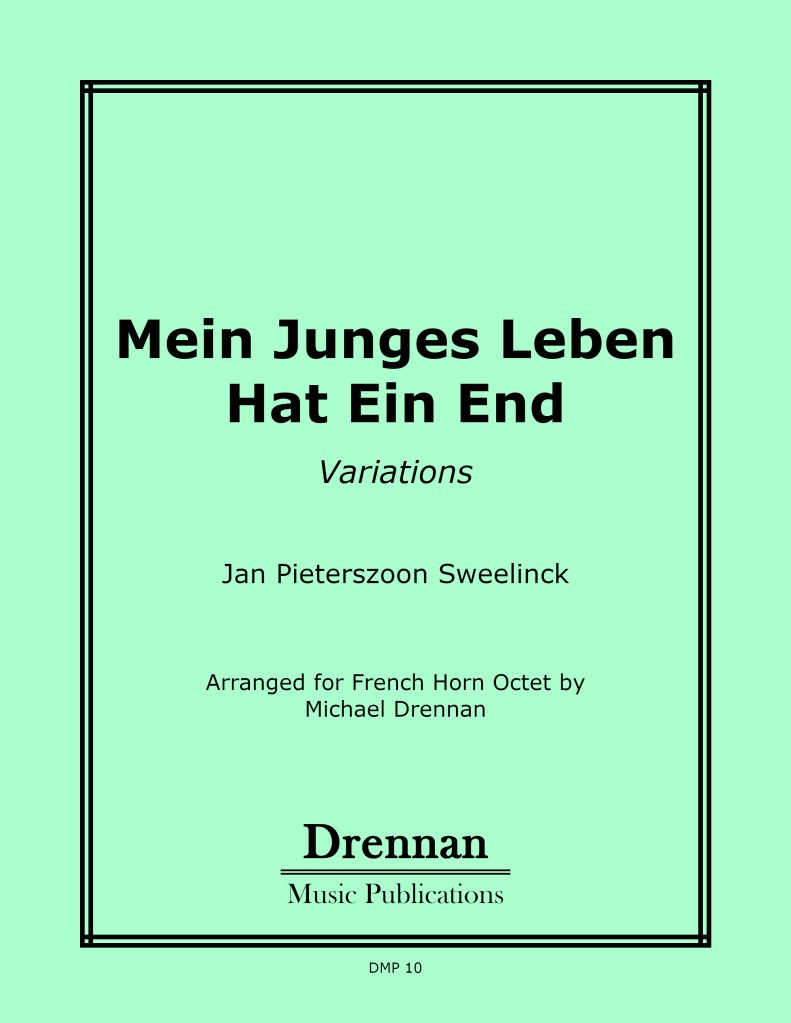
Mein Junges Leben Hat Ein End
Variations
Jan Pieterszoon Sweelinck
Arranged for Horn Octet by Michael Drennan
Composed for Organ originally the piece starts with the presentation of the theme, and proceeds to go through a number of variations. This arrangement starts with the theme and a bassline, adding the other voices as the theme continues. The first two iterations of the theme are played by two different groups of four horns, while the last two variations use all eight horns.
Available from:
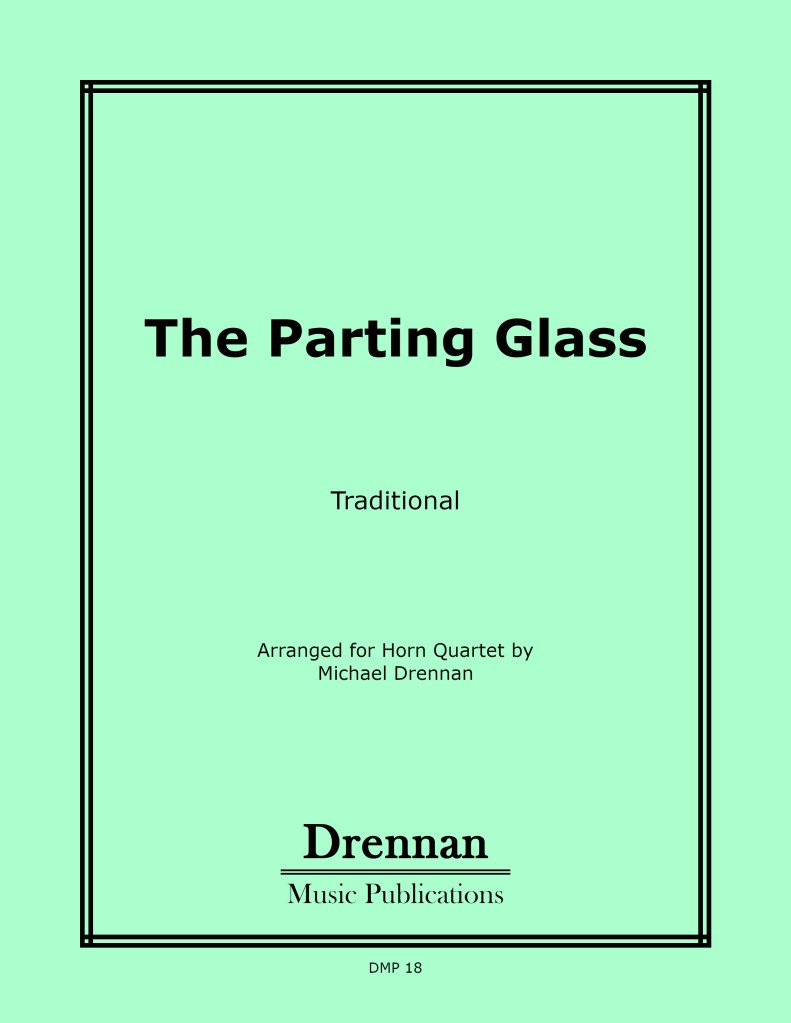
The Parting Glass
Traditional
Arranged for Horn Quartet by Michael Drennan
The Parting Glass is a Traditional Scottish song, often sung at the end of a gathering of friends. This version was written for French Horn Quartet, starting with a slow introduction. The middle section uses a combination of 6/8 and 3/4 time, and then has a peaceful and slow ending.
Available from:
Hallelujah
Leonard Cohen
Arranged for Horn Quartet by Michael Drennan
Hallelujah is a very famous song by Leonard Cohen, and is well known as being in the movie Shrek. This version includes quotes from Nearer My God to Thee.
Available from:

SOLO HORN With PIANO
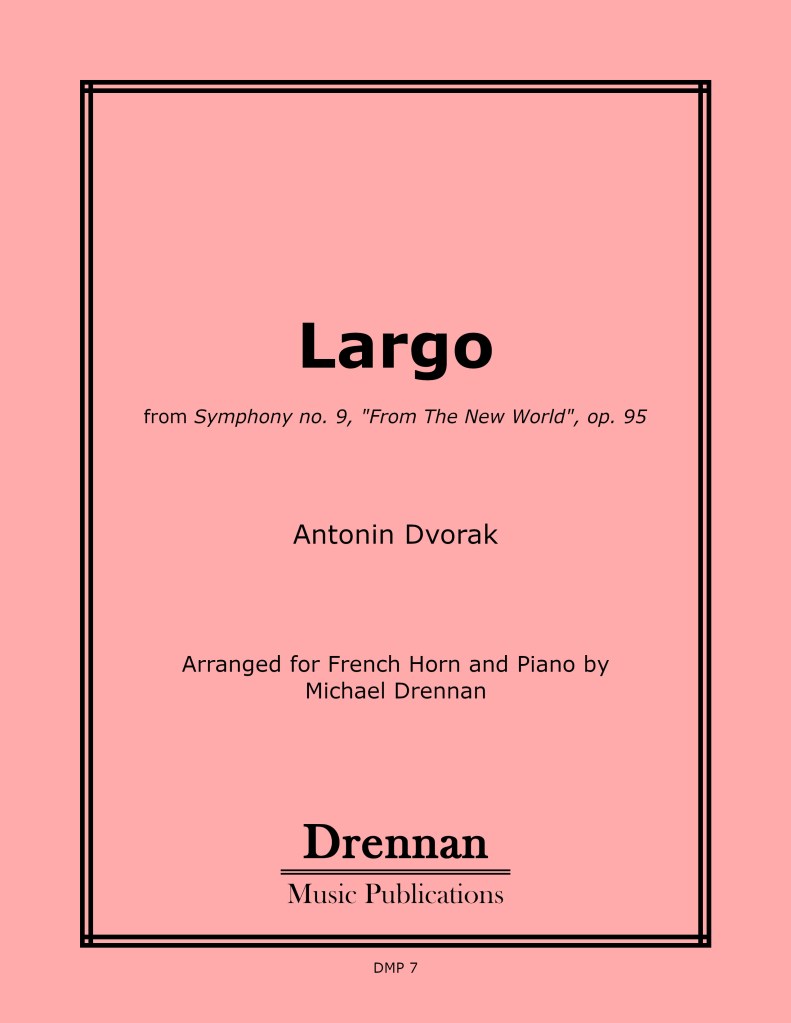
Largo
from Symphony no. 9, “From the New World”, op. 95
Antonin Dvorak
Arranged for Solo French Horn and Piano by Michael Drennan
This piece was arranged for a wedding, and it worked very well. The arrangement only uses the “Going Home” melody, without going into the contrasting B section at all. It also allows the pianist to shine as well, with the various counter melodies in the piece.
Available from:
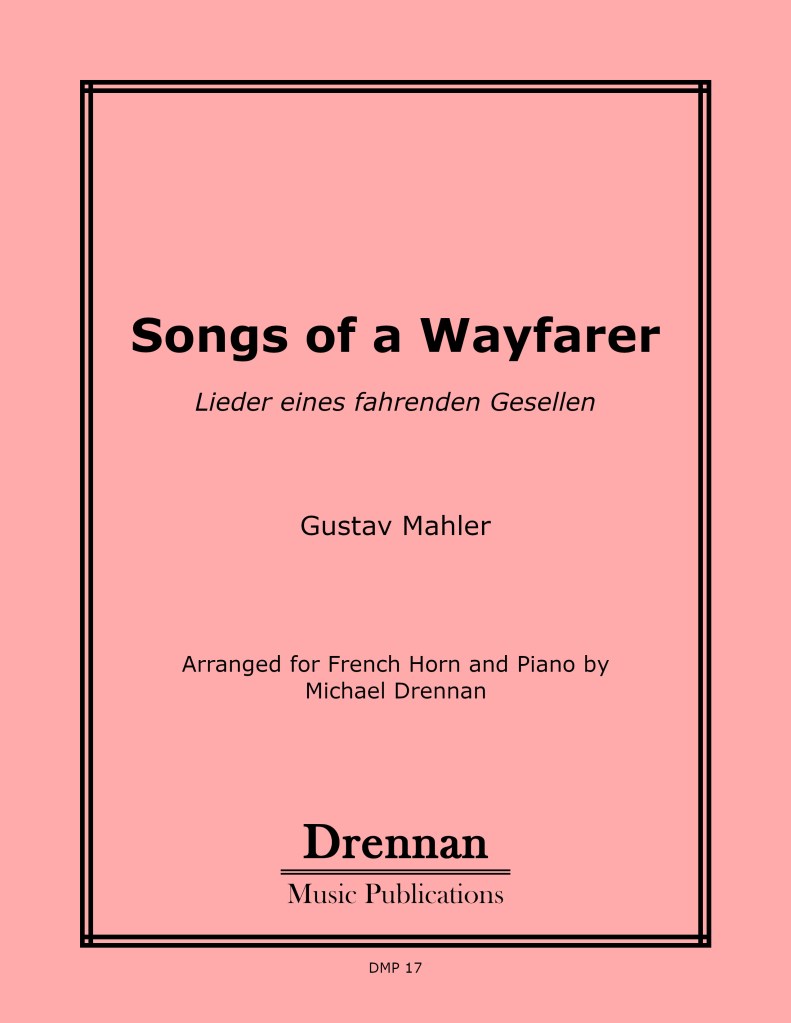
Songs of a Wayfarer
Lieder eines fahrenden Gesellen
Gustav Mahler
Arranged for Solo French Horn and Piano by Michael Drennan
Lieder eines fahrenden Gesellen is a song cycle written by Gustav Mahler from 1884 to 1885. The story that this piece tells is that of a Wayfarer or Traveler who loses the love of his life to another (I. My Sweetheart’s Wedding Day). He initially finds solace by walking in nature ((II. This Morning I Went Through The Fields), but later everything reminds him of his sweetheart (III. I Have A Burning Knife). He later finds peace under a linden tree, letting the flowers fall on him (IV. The Two Blue Eyes of My Sweetheart).
Available from:
METHOD BOOK
Band and Orchestra Method Book
Written by Michael Drennan and Christopher Tolbert
Written out of a need to teach Band and Orchestra instruments in the same class, this method book was developed over two to three years to serve the students of Tolbert Music.
Available from:

 Drennan Music Publications